

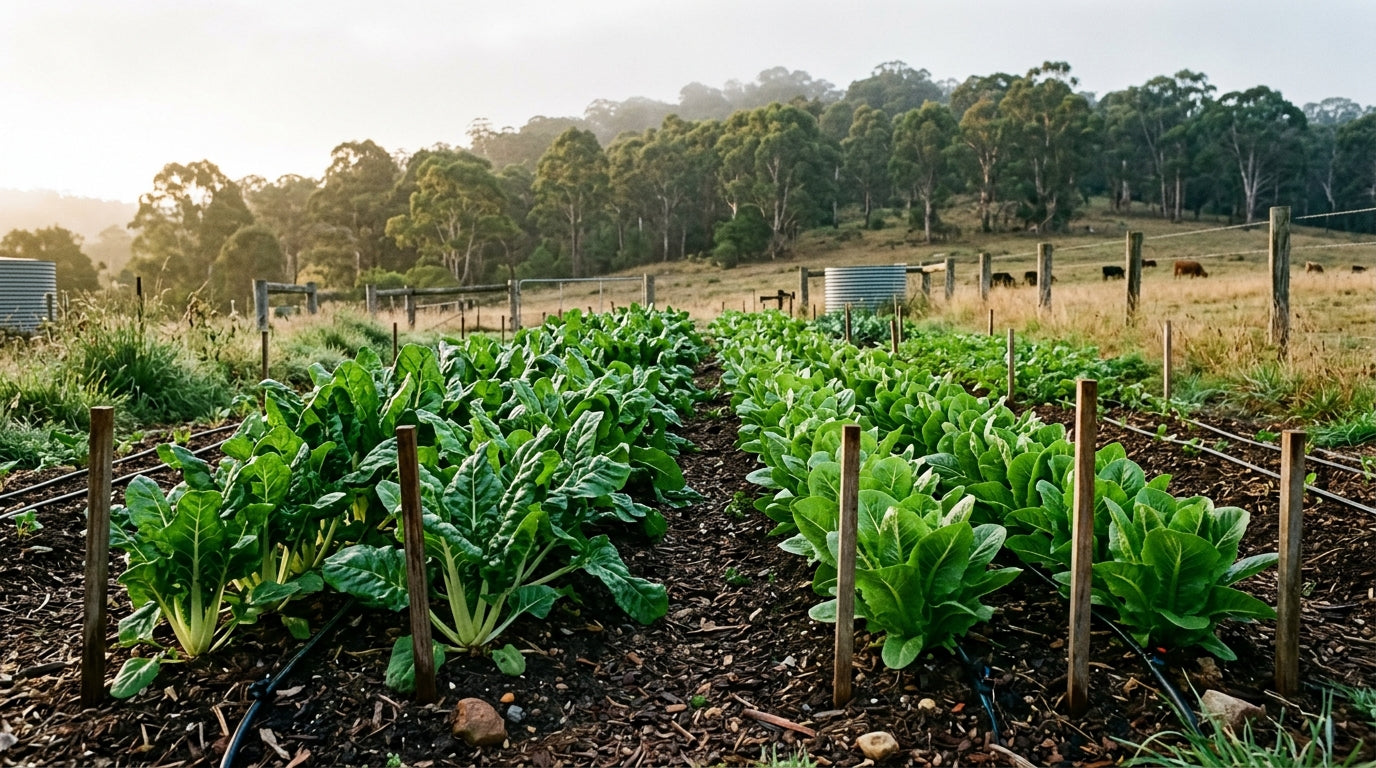
Walk a crop at dawn and you're walking through a conversation. Not one you can hear, but one the insects can read perfectly well. Every plant in the paddock is releasing a fine blend of airborne chemicals, and the make-up of that blend tells a passing pest insect whether to land and feed or move on. Pest pressure isn't random. And one of the levers that shapes it sits in the fertiliser shed.
This piece reviews what the peer-reviewed literature now shows about plant volatile organic compounds (VOCs), how nitrogen management changes the signals a crop broadcasts, and what that means for integrated pest management (IPM) on an Australian farm. It's written for growers, agronomists and the technically curious — and it's grounded in the way we farm at Your Farmer®: feed the system, not just the plant.
Key Takeaways
- Plants emit blends of volatile compounds — over 1,700 are known — and insects use them to choose host plants12.
- High nitrogen made tomato plants emit far less of eight defensive terpenes and pulled in significantly more silverleaf whitefly — on smell alone3.
- A 50-year review found 135 studies of more pest damage under nitrogen fertilisation, against fewer than 50 reporting less4.
- Silverleaf whitefly is a major Australian cotton pest, and our own IPM already leans on conserving the beneficial insects that plant volatiles recruit56.
- The practical lesson is consistent: optimise nitrogen, don't maximise it.
What a plant volatile actually is
Researchers have identified more than 1,700 volatile organic compounds emitted from plant tissues, and a single crop's blend shifts with species, cultivar, growth stage and growing conditions1. These are low-molecular-weight chemicals made through secondary metabolic pathways, and they fall into three main families: terpenes (mono- and sesquiterpenes), benzenoids and phenylpropanoids, and fatty-acid derivatives such as the green leaf volatiles you smell in cut grass7.
Ecologically, the blend does real work. It draws in pollinators, repels herbivores, primes neighbouring plants to ready their own defences, and recruits the predators and parasitoids that attack pests — the three-way relationship scientists call a tritrophic interaction8. In a crop, the composition of that volatile signature has direct consequences for how much pest pressure a paddock carries.
How does a pest insect read the blend?
Insects locate host plants through a mix of smell, sight, touch and taste — a framework first set out by Painter in 1951 and confirmed many times since9. For many of the pest species that matter to growers, olfactory cues carried by plant VOCs are the dominant factor in that choice2. The insect smells its way in before it ever sees the plant.
A 2026 review in Environmental Entomology by Thompson, Russavage and colleagues makes an important point for anyone managing a crop: individual volatiles and whole blends are multifunctional10. The same compound that deters one insect can attract another. Change one signal and the effect ripples through the entire insect community on the crop — pests, predators and pollinators alike. That interconnectedness is exactly why a systems lens beats a single-target one here.
The nitrogen–volatile–pest nexus
The clearest demonstration of the link comes from Islam and colleagues (2017), who fed tomato plants high, normal and below-normal nitrogen and then tested them against silverleaf whitefly (Bemisia tabaci) in wind-tunnel and olfactometer trials3. The high-nitrogen plants were significantly more attractive to whitefly females — and when the researchers stripped out every visual cue and left only smell, the whiteflies still chose the high-nitrogen plants. The signal driving host selection was chemical, not visual.
Gas chromatography–mass spectrometry told the mechanistic story. As nitrogen went up, the plants emitted markedly less of eight key defensive terpenes — β-pinene, (+)-4-carene, α-terpinene, p-cymene and β-phellandrene among the monoterpenes, and α-copaene, β-caryophyllene and α-humulene among the sesquiterpenes3. What this means in practice is blunt: luxury nitrogen quietly strips a plant of the aromatic armour it would otherwise wear.
Why this matters on an Australian farm
This isn't a foreign curiosity. Silverleaf whitefly is a recognised major pest of Australian cotton, costly both through feeding damage and through the honeydew that contaminates lint5. The Islam work was done overseas, so treat the species detail as indicative rather than local — but the underlying dynamic, more soluble nitrogen meaning a more attractive, less-defended plant, is precisely the dynamic our growers manage in NSW cotton and horticulture11.
It lines up with the local management orthodoxy, too. Australian cotton IPM is built on conserving natural enemies and avoiding early broad-spectrum sprays5, and CSIRO has worked specifically on encouraging the parasitoids that keep silverleaf whitefly in check6. Nitrogen rate sits upstream of all of it. Work in Bt cotton found a moderate nitrogen rate supported growth while holding cotton aphid populations down, whereas high and very high rates reversed the benefit and lifted pest pressure — a non-linear, dose-dependent response12.
The wider evidence on nitrogen and pests
Step back from any single trial and the pattern holds. A review spanning 50 years of agricultural research counted 135 studies reporting more plant damage or higher pest numbers in nitrogen-fertilised crops, against fewer than 50 reporting less4. The weight of evidence is one-directional: excess nitrogen tends to raise pest susceptibility, through more than one pathway.
A 2021 review in Frontiers in Sustainable Food Systems put the question sharply — when the medicine feeds the problem13. Its answer: nitrogen lifts soluble amino acids and sugars in plant sap, effectively improving the crop's nutritional value for sap-feeding pests like aphids, whitefly and planthoppers. So the plant becomes both easier to find and better to eat. That's a poor combination to engineer into a paddock on purpose.
Terpenes are the plant's own deterrent
The terpenes that excess nitrogen suppresses aren't passengers — they're the defence. β-caryophyllene is a good example of the multifunctionality at work: it deters herbivores, recruits parasitoid wasps that prey on pest larvae, and carries antimicrobial activity besides8.
The implication is almost circular, and worth sitting with. The same nutrition decision that determines how visible a crop is to pests also determines how well-armed it is against them.
Volatiles as a call for reinforcements
Beyond direct deterrence, herbivore-induced plant volatiles (HIPVs) act as a distress call. When a herbivore starts feeding, the plant shifts its volatile profile to summon parasitoids and predators — and a 2023 review in Cells rates this HIPV-mediated tritrophic signalling among the most promising avenues in sustainable pest management, because it leans on relationships that already exist rather than on a new synthetic input14. It's the same logic CSIRO and the cotton industry already apply when they conserve whitefly's natural enemies6.
Here's the connection that ties the article together. A plant kept in balanced nutrition holds both capacities at once — it repels pests directly through terpene emission and recruits beneficials through HIPV signalling. Overload it with nitrogen and you dull both in a single stroke.
What this means in the paddock
Translated to management decisions, the research points one way. Optimise nitrogen, don't maximise it. Moderate, balanced application supports yield and keeps the plant's own resistance machinery running; excess suppresses defensive terpenes and sweetens the sap for sap-feeders. Read your pest pressure as a signal. A spike in whitefly, aphid or thrips after a heavy nitrogen application may be a chemical-signalling response, not bad luck. And protect the beneficials — habitat for parasitoids and predators, plus balanced nutrition, lets the crop's own defences do the work.
This is the practitioner's reading of a framework like John Kempf's Plant Health Pyramid, which describes immunity building in stages — from complete photosynthesis through protein and lipid synthesis to abundant secondary metabolites — with each stage conferring resistance to a more complex group of pests15. Balanced nutrition, not maximal nutrition, is the foundation that progression stands on.
There's an older idea underneath it, and it's the one we farm by. Observe the system before you intervene in it. A paddock isn't a set of independent inputs and outputs; it's a living whole in which a fertiliser decision becomes a pest outcome by a route you can't see from the spreadsheet. Get the soil and the nutrition right, and a great deal of pest management simply stops being necessary. You can read more about that approach on our ecological farming page, and about the growers behind your food.
Conclusion
What we put on our soils changes the chemical language our crops speak to the insect world. Excess nitrogen doesn't just cost money — it quietly disarms the defences plants spent millennia evolving. Optimise rather than maximise, and you support crop health, lower pest pressure, and let the ecology carry more of the load. It's the same principle behind every eco-grown veggie box we deliver, and the reason we measure our food against the outcomes that matter.

Share:
Why Healthy Plants Don't Get Eaten: The Hidden Science Behind Pest-Free Crops