

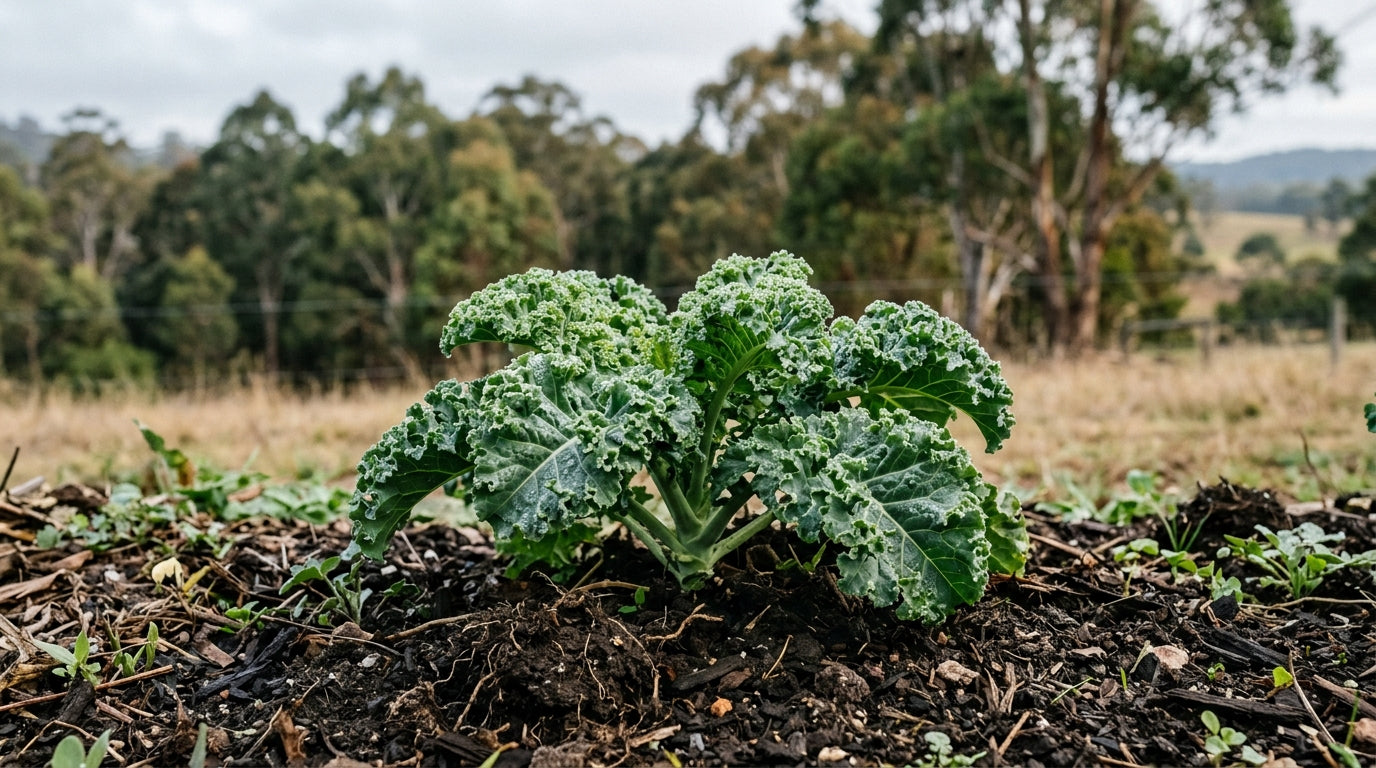
Spend enough seasons watching crops and you notice something the spray diary never quite explains: in the same paddock, under the same pest, some plants get hammered and others are barely touched. It isn't luck, and it isn't only genetics. A growing body of science says the difference is health — that a genuinely healthy plant is, to an insect, a poor meal and a poor target. This is the plant-health view of pest resistance, and it changes where you put your attention: not on the pest, but on the plant and the soil that built it.
This piece sets out the framework — why healthy plants resist — and what it asks of a grower. For the deeper dive into the volatile chemistry that carries the signal, see the companion review on plant volatiles and nitrogen management. It's the way we farm at Your Farmer®: build the plant's health and most of the pest problem never arrives.
Key Takeaways
- Chaboussou's trophobiosis theory holds that pests and diseases target plants with sap rich in free amino acids and sugars — a hallmark of incomplete, unbalanced metabolism1.
- A healthy plant converts those simples into complete proteins and complex defensive compounds, becoming both less nutritious and less attractive to pests12.
- Excess nitrogen breaks this: high-nitrogen tomatoes emitted fewer defensive terpenes and drew far more whitefly, on smell alone3.
- Australian IPM already works this way — conserving the beneficial insects a healthy crop recruits45.
- Plant health is built, in stages, from the soil up — and balanced nutrition is the foundation.
The idea that healthy plants resist pests
The clearest articulation of this view is Francis Chaboussou's trophobiosis theory, which proposes that a plant only becomes susceptible to a pest or pathogen when its sap carries a surplus of free amino acids and reducing sugars — the simple, soluble nutrients an insect or fungus can use directly1. In Chaboussou's reading, susceptibility is a metabolic state, not a fixed trait. A plant whose metabolism is running cleanly — turning simple nutrients into complete proteins and complex compounds — leaves little on the table for a pest to feed on.
It's a deceptively radical reframe. The question stops being “what's eating my crop, and what kills it” and becomes “why is this plant edible in the first place”. That second question is one a grower can actually act on.
What the plant's chemistry is doing
A healthy plant invests in defence chemistry, and terpenes are central to it. These compounds — the same family behind the scent of eucalyptus and lavender — repel herbivores directly, and some are outright toxic or antifeedant to pests2. Others act as a distress call: when a herbivore starts feeding, the plant shifts its volatile profile to summon the parasitoids and predators that attack the pest6. A well-built plant, in other words, defends itself on two fronts at once — it's unappealing to eat and it calls in reinforcements.
Lose that chemistry and you lose both fronts together. The terpene blend isn't decoration; it's the visible output of a plant whose metabolism has reached the point where it can afford to make defences.
The Plant Health Pyramid: resistance built in stages
The modern practitioner's version of Chaboussou's insight is John Kempf's Plant Health Pyramid, which describes immunity building in four levels7. A plant first needs complete photosynthesis; then complete protein synthesis (so free amino acids don't accumulate in the sap); then the capacity to store lipids; and finally the abundant production of secondary metabolites — the terpenes and related compounds that carry defence. Each level, the framework argues, confers resistance to a progressively more complex group of pests and diseases.
What this means in practice is that resistance isn't a switch you flip with a product — it's a state you build from the soil up. And the foundation of the whole structure is balanced nutrition. Not maximal nutrition. Balanced.
How over-fertilising breaks it
The fastest way to knock a plant down the pyramid is to overload it with nitrogen. When nitrogen arrives faster than the plant can build it into complete proteins, free amino acids and soluble sugars pool in the sap — exactly the trophobiotic state Chaboussou described18. A 2021 review confirmed the mechanism directly: nitrogen input raises soluble amino acids and sugars, improving the crop's nutritional value for sap-feeders such as aphids and whitefly8.
The chemistry follows. In a controlled study, tomato plants given high nitrogen emitted significantly less of eight defensive terpenes and became markedly more attractive to silverleaf whitefly — and the whiteflies chose them on smell alone, with all visual cues removed3. The plant looked greener and lusher; its invisible defences had been stripped away. Across 50 years of research the pattern is consistent — one review counted 135 studies of greater pest damage under nitrogen fertilisation against fewer than 50 showing less9.
Why this holds on an Australian farm
This isn't theory imported from somewhere else. Silverleaf whitefly is a major pest of Australian cotton, and the local management orthodoxy already runs on plant-health logic — conserve the natural enemies, avoid early broad-spectrum sprays that break the system, and don't hand pests an easy meal4. CSIRO has worked specifically on encouraging whitefly's natural enemies5, and Australian IPM resources frame the same conserve-the-beneficials approach for growers across the northern and southern systems10. A plant kept in balanced nutrition is what makes that approach work — it's the crop holding up its own end.
What this asks of a grower
The plant-health view turns into a short list of habits. Feed the soil, not just the plant — biological soil function is what lets a crop complete its metabolism rather than stall on a flush of soluble nitrogen. Optimise nitrogen, don't maximise it — match supply to what the plant can actually build into protein. Read pest pressure as feedback — a susceptible crop is telling you something about its nutrition and its soil. And protect the beneficials, because a healthy crop recruits them and broad-spectrum sprays evict them.
There's a philosophy under the practice, and it's an old one: observe the system before you intervene in it. A pest outbreak isn't really the problem — it's the symptom of conditions the plant and soil created. Treat the conditions and the symptom tends to fade. That's the same principle behind every eco-grown veggie box we grow, and the reason we measure food against outcomes like nutritional density rather than what's merely absent from it.
Conclusion
Healthy plants don't get eaten because health, in a plant, is the absence of the very thing a pest needs — a sap full of easy nutrients and a body short on defences. Build the plant's health from the soil up, keep its nutrition balanced, and you're not fighting pests so much as removing the reasons they came. It's slower than a spray and far more durable. And it's why we farm the way we do — you can meet the growers behind your food and see it for yourself.


Share:
The Science of Plant Volatiles: How Nitrogen Management Shapes Pest Attraction on Your Farm