

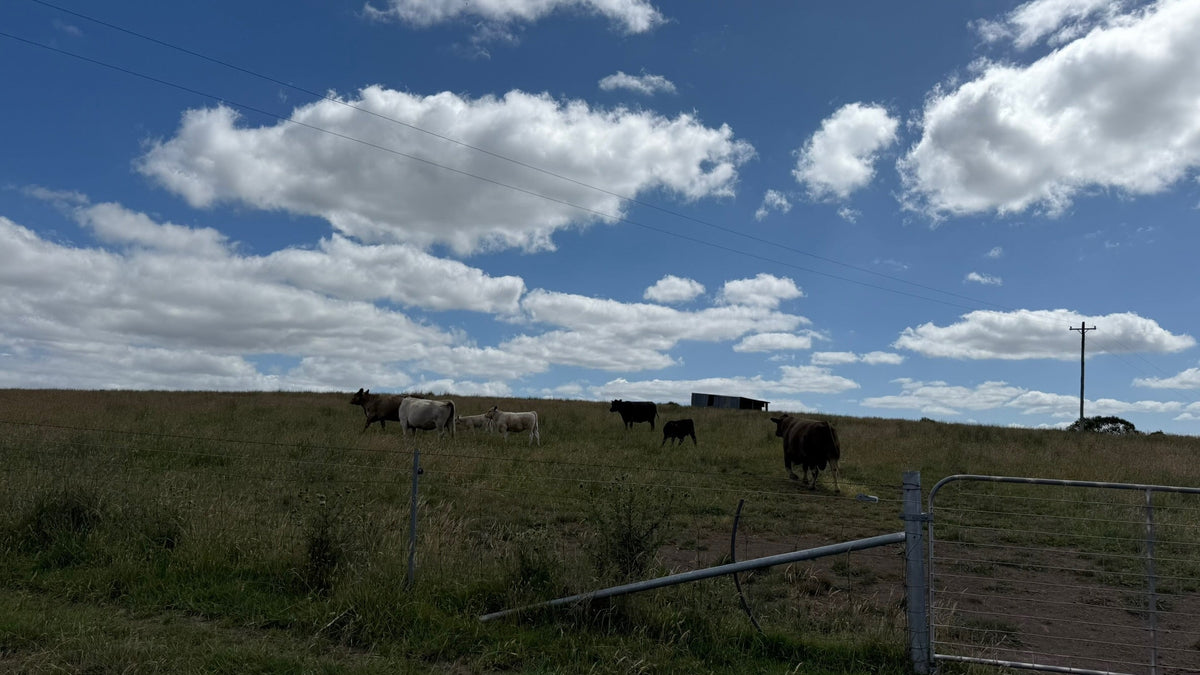
The Southern Highlands' temperate climate, basalt-rich soils and reliable rainfall grow nutrient-dense pastures that may contribute to the distinctive eating quality of grass-fed beef from this region.
Wine lovers talk about terroir — the way climate, soil and geography leave a fingerprint on what ends up in the glass. Research from the University of Melbourne found that climate, soil type and pasture species directly influence cattle productivity in southern Australia, suggesting the same principle may apply to beef. For grass-fed beef, Southern Highlands conditions create a particular combination of altitude, geology and pasture type that can shape everything from fatty acid profiles to aroma compounds in the finished cut. This article traces that chain from climate through to the plate, drawing on peer-reviewed science and government research.
What Is Terroir — and Why Does It Apply to Beef?
Terroir is a French term traditionally used in viticulture to describe how a specific place — its soil, climate, altitude and biological community — imprints on the character of a product. A 2019 review published in Frontiers in Nutrition extended this idea to livestock, proposing that plant diversity and phytochemical richness in pastures directly affect the biochemical richness of meat and dairy. In other words, what grows in the paddock may influence what you taste on the plate.
The same researchers noted that epidemiological studies critical of red meat consumption often do not discriminate among meats from livestock fed high-grain rations as opposed to livestock foraging on landscapes of increasing phytochemical richness. This distinction matters. When cattle graze diverse pastures shaped by a specific environment, the interplay between soil minerals, plant compounds and animal metabolism may produce a biochemical profile unique to that place — a form of meat terroir.
The Southern Highlands Climate: Cool Elevation and Reliable Rainfall
The Southern Highlands sits at approximately 500 to 900 metres above sea level, well above the coastal plains of NSW. Bureau of Meteorology records for Moss Vale show a mean maximum temperature of 18.9 °C and a mean minimum of 8.2 °C, with annual rainfall averaging around 785 mm. This temperate oceanic climate (classified as Cfb) creates cooler growing conditions than much of coastal and western NSW, favouring a different suite of pasture grasses.
|
Climate Factor |
Southern Highlands (Moss Vale) |
|
Elevation |
~678 m above sea level |
|
Mean maximum temperature |
18.9 °C |
|
Mean minimum temperature |
8.2 °C |
|
Annual rainfall |
~785 mm (up to 1,600 mm on the Robertson plateau) |
|
Climate classification |
Temperate oceanic (Cfb) |
|
Pasture growing season |
Year-round with cool-season dominance |
On the Robertson plateau, rainfall can reach 1,000 to 1,600 mm per annum, creating among the most reliably watered agricultural land in NSW. This reliable moisture, combined with moderate temperatures, supports year-round pasture growth — a critical factor for grass-finished beef production.
The Southern Highlands Climate: Higher Elevation, Cooler Conditions and Regular Rainfall
The Southern Highlands forms part of the Great Dividing Range, with the region sitting between 500 and 900 metres above sea level. Around Moss Vale, the Bureau of Meteorology’s Moss Vale AWS station records an elevation of 678 metres, a mean maximum temperature of 19.0 °C, a mean minimum temperature of 8.3 °C, and average annual rainfall of 813.3 mm.
These figures help explain why the Southern Highlands is often described as a cool, moist part of NSW. They also provide useful context for pasture-based farming. NSW Government guidance notes that temperate and cool-season pastures are important in southern, central and tablelands grazing systems, with reliable growth during autumn, winter and spring.
|
Climate Factor |
Southern Highlands / Moss Vale Context |
|
Regional elevation |
500 to 900 m above sea level |
|
Moss Vale AWS elevation |
678 m above sea level |
|
Mean maximum temperature |
19.0 °C |
|
Mean minimum temperature |
8.3 °C |
|
Annual rainfall |
813.3 mm at Moss Vale AWS |
|
Pasture context |
Temperate pastures provide reliable autumn, winter and spring growth in tableland grazing systems |
In higher-rainfall areas associated with Robertson Basalt Tall Open-forest, NSW Environment lists rainfall at 1,000 to 1,600 mm per annum. This does not apply evenly across the whole Southern Highlands, but it shows how rainfall can vary across the region’s local microclimates.
For grass-fed and pasture-based livestock systems, these climate patterns are relevant rather than determinative. Cooler conditions, regular rainfall and temperate pasture species can support grazing and finishing systems, but pasture outcomes still depend on soil, season, stocking rates and farm management.
Basalt Soils and Soil Health
Beneath the green paddocks of the Southern Highlands lies a layer of volcanic geology. The NSW Scientific Committee describes the region's high-fertility soils derived from Tertiary basalts, mainly the Robertson Basalt and Kangaroo Valley Basanite. These ancient volcanic deposits have broken down over millennia into mineral-rich clay loams that hold moisture and nutrients effectively. The fertility is well documented — less than 15 per cent of the original basalt tall open-forest remains, the rest cleared for agriculture over generations.
What makes basalt-derived soils relevant to beef? Healthy soils support diverse pasture growth, and CSIRO research on soil carbon notes that farmers who adopt management practices that build soil carbon may gain a more productive, sustainable and resilient farming system. The mineral composition of the soil feeds the pasture, the pasture feeds the animal, and the animal's diet influences the composition of its meat.
-
Volcanic origin: Basalt-derived soils provide a broad mineral profile that supports diverse pasture species
-
Moisture retention: Clay loam structure holds water through dry spells, helping maintain pasture quality
-
Soil biology: Carbon-rich soils foster microbial communities that cycle nutrients to plant roots
-
Agricultural history: Generations of pastoral use reflect the long-standing productivity of this landscape
Temperate Pasture Grasses That Thrive in the Highlands
The cool, wet climate of the Southern Highlands favours a specific group of pasture plants. NSW Department of Primary Industries guidance for the Southern Tablelands recommends temperate perennial pastures including phalaris, cocksfoot, ryegrass and clover — all C3 grasses and legumes that photosynthesise most efficiently in moderate temperatures.
Why does this matter for beef? Research modelling southern Australian beef systems found that C3 temperate pastures, such as phalaris, supported higher carrying capacity than C4 subtropical pastures like kikuyu, with poorer feed quality from subtropical grasses limiting annual stocking rates. Pasture type — driven by climate — directly affects how well cattle grow and finish on pasture.
-
Phalaris: A deep-rooted perennial that thrives in cool, high-rainfall zones and provides reliable feed through winter
-
Cocksfoot: Drought-tolerant and shade-tolerant, adding diversity to pasture swards
-
Perennial ryegrass: High digestibility and palatability, supporting strong weight gain in grazing cattle
When cattle graze these mixed temperate pastures, they take in a range of plant compounds — the phytochemicals that researchers suggest may influence the biochemical profile of the finished meat. The more diverse the pasture, the more varied the input to the animal's metabolism.
How Grass Finishing Shapes Flavour and Eating Quality
Australian researchers from CSIRO and the University of Melbourne published a key study in the Journal of Agricultural and Food Chemistry examining the sensory and flavour chemistry characteristics of Australian beef. Their findings showed that grilled beef flavour, dairy-fat notes and sweetness increased with marbling level, while sourness and astringency decreased. Intramuscular fat — or marbling — was identified as an important contributor to flavour, flavour release and texture.
The same study found that inherent differences between grass-fed and grain-fed Angus cattle were minimal when intramuscular fat content exceeded approximately 5 per cent. This suggests that while finishing system matters, the degree of marbling — itself influenced by breed, age and nutrition — may be an equally important driver of eating quality. For grass-finished cattle in regions like the Southern Highlands, achieving adequate marbling through well-managed temperate pasture is key.
A widely cited systematic review in Nutrition Journal examined fatty acid profiles and antioxidant content in grass-fed versus grain-fed beef across three decades of research. The review found that grass-finished beef tends toward a higher proportion of stearic acid (a cholesterol-neutral fatty acid) and lower levels of myristic and palmitic acids. Diet-derived compounds also appear to influence aroma, contributing to the distinct sensory character many associate with pasture-raised meat.
|
Attribute |
Grass-Fed Beef |
Grain-Fed Beef |
|
Omega-6 : Omega-3 ratio |
~1.53 |
~7.65 |
|
Conjugated linoleic acid (CLA) |
2–3× higher |
Baseline |
|
Beta-carotene |
Elevated |
Lower |
|
Alpha-tocopherol (Vitamin E precursor) |
Elevated |
Lower |
|
Reported aroma/flavour notes |
Pasture-derived volatiles |
Grain-derived volatiles |
Data drawn from Daley et al. (2010) and Frank et al. (2016).
What Grass Fed Beef May Offer Beyond Flavour
Beyond eating quality, the nutritional composition of pasture-raised beef has attracted research interest. A 2024 BMC Veterinary Research study involving pasture-based Australian Angus, Hereford and Wagyu cattle measured long-chain omega-3 fatty acids, finding total EPA, DHA and DPA contents of 21.5 to 28.8 mg per 100 g tissue depending on breed. The researchers concluded that pasture-based production may provide a long-term approach to producing beef with consistent eating quality and health-promoting long-chain omega-3 fatty acids.
Earlier research supports these findings. The systematic review by Daley and colleagues found that grass-based diets elevate precursors for Vitamin A and E, as well as antioxidants including glutathione and superoxide dismutase, compared to grain-fed cattle. These differences stem from what the animals eat — fresh pasture grasses provide alpha-linolenic acid, the precursor that accumulates as long-chain omega-3 fatty acids in muscle tissue.
-
Omega-3 fatty acids: Grass-fed beef may contain a more favourable omega-6 to omega-3 ratio than grain-fed beef
-
Conjugated linoleic acid (CLA): Pasture feeding has been associated with higher CLA levels in peer-reviewed research
-
Antioxidant precursors: Fresh forage provides beta-carotene and alpha-tocopherol, precursors to Vitamins A and E
-
Consistent eating quality: Pasture-based systems may support steady intramuscular fat development linked to flavour
The role of soil health in this system should not be overlooked. CSIRO research on soil carbon sequestration shows that increasing carbon stored in agricultural soils can help improve productivity and resilience. Healthy soils grow better pasture, which in turn supports better nutrition for grazing cattle — a cycle that connects the ground beneath Southern Highlands paddocks to the quality of grass-fed beef Southern Highlands producers raise.
Grass-fed beef can be appreciated for its taste, but its story begins long before it reaches the kitchen. From soil biology to pasture quality, every part of the farming system plays a role in the final product. Through Your Farmer, families can access beef raised with this broader ecological picture in mind — food that reflects both the paddock it came from and the people who raised it.
Why Provenance and Traceability Matter
When a producer claims their beef is grass-fed, consumers rely on trust — they cannot verify the claim at the point of purchase. The ACCC has made clear that when making promotional claims about food products, the "who", "what", "where" and "how" must be accurate under Australian Consumer Law.
Food Standards Australia New Zealand reinforces this framework through Standard 1.2.7 of the Food Standards Code, which governs nutrition content claims, health claims and related claims about food — all of which are subject to fair trading laws prohibiting false, misleading or deceptive representations under Australian Consumer Law. For consumers seeking grass-fed beef from Southern Highlands provenance, this regulatory environment underscores why knowing where your meat comes from — and how it was raised — matters.
Traceability from paddock to plate gives food enthusiasts confidence that the claims on the label reflect reality. For those looking to explore the farm fresh meat Southern Highlands producers offer, understanding the connection between regional climate, pasture and production method is a practical first step.
Frequently Asked Questions
Does the type of grass cattle eat affect the flavour of beef?
Research suggests it can. Australian researchers from CSIRO and the University of Melbourne found that trained panel sensory differences in flavour corresponded with increases in aroma volatiles and changes in non-volatile flavour compounds. The type of pasture — and what that pasture draws from the soil — contributes to the range of compounds present in the finished beef. Cool-climate temperate grasses like phalaris and ryegrass, common in the Southern Highlands, offer different phytochemical inputs than subtropical species.
How do climate and soil influence pasture quality for beef cattle?
Climate determines which pasture species thrive, and pasture species determine feed quality. University of Melbourne research modelling southern Australian beef systems found that poorer feed quality from subtropical kikuyu pastures limited carrying capacity compared to temperate phalaris pastures. Regions like the Southern Highlands, with cool temperatures and reliable rainfall, favour the C3 temperate grasses associated with higher feed quality and livestock productivity.
How can I verify that beef is genuinely grass-fed?
Look for producers who offer clear traceability from paddock to plate. Under ACCC guidance, businesses must be able to prove the claims they advertise, and claims should be true, accurate and based on reasonable grounds. For grass-fed beef, ask about the farm's location, pasture management practices and whether the cattle are finished on grass rather than grain.

Share:
Farm Fresh Meat from the Southern Highlands: What Dural and Hills District Families Need to Know
What Does Soil Health Have to Do with the Grass-Fed Beef on Your Plate?