

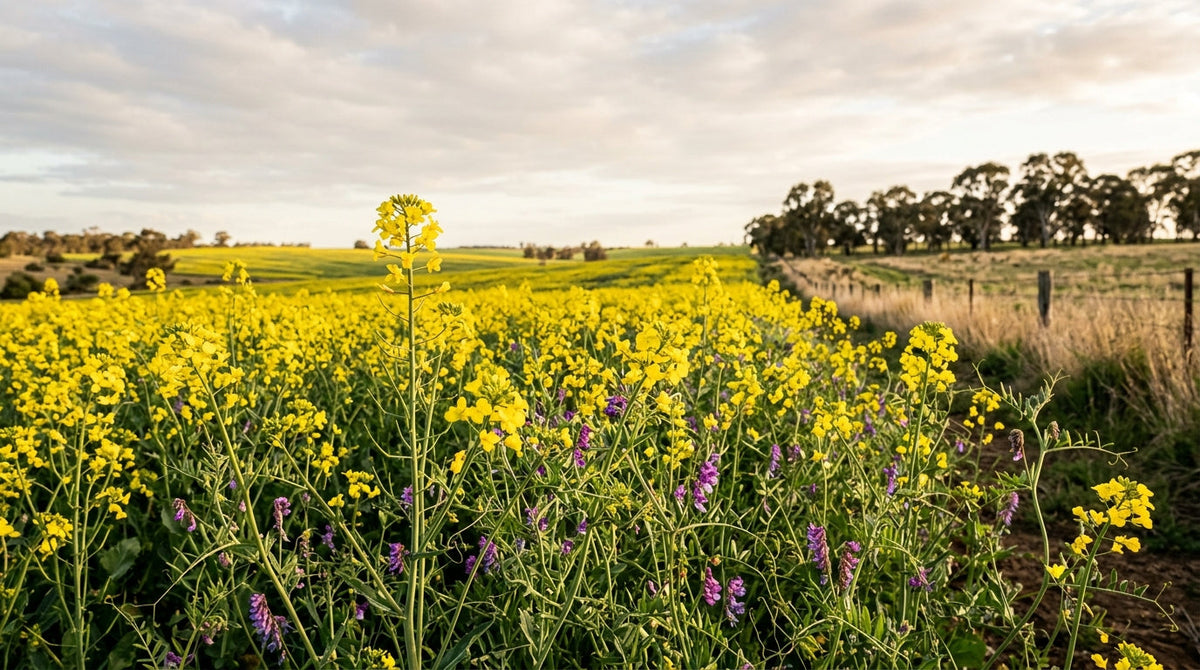
Intercropping means growing two crops in the same paddock, in the same season, and harvesting both. On 9 October 2026, The Land told the story of Brendan Pattison, a grower at Marrar in the NSW Riverina, who sows canola with vetch and wheat with faba beans 1. The result is fewer sprays, less bought-in fertiliser and two products off every intercropped hectare.
His farm deserves celebrating, not for any label (the article doesn't give it one) but for what his paddock is doing. It's exactly the kind of thinking ecological farming is built on: design the system so the plants do some of the work the spray rig used to do.
Intercropping is sowing two (or more) harvestable crops together, so they share the paddock for the whole season. It's different from a cover crop, which is grown to protect or feed the soil and usually isn't harvested. It's also different from companion cropping, where the second crop is grazed or sprayed out before the main crop is harvested 2.
The classic pairing is a grain with a legume. The legume (vetch, peas, beans, lentils) works with soil bacteria to pull nitrogen from the air. Because the legume finds most of its own nitrogen, it doesn't compete with its partner for the soil's supply, and it leaves nitrogen behind for the next crop. Either way, less has to come out of a bag. That matters for pests as well as costs: we've written about how nitrogen management shapes pest attraction. In Brendan's words, the two crops feed each other, so he isn't relying on heavy fertiliser 1.
Brendan has about 150 hectares of canola and vetch this year, sown early in April 1. He more than doubled his vetch seeding rate, from 12 to 25 kg per hectare, and the vetch will be sold for seed 1. He has also tried canola with beans and canola with lentils in earlier years, and this season he has a strip of wheat and faba beans running through a conventional wheat crop 1.

He hasn't stopped using inputs. He still applies gypsum, a liquid nitrogen fertiliser (UAN) and composted chicken manure pellets for phosphorus 1. What's changed is how much. Synthetic fertiliser use is down, and fungicide has mostly gone: his intercrop usually gets none. This year it got one pass, because a mild winter brought on botrytis (a fungal disease) early 1. His agronomist, David Bushell of Echidna Ag, says a conventional vetch crop typically gets three 1.
Bushell also found disease pressure was lower, and the mixed crop was easier to windrow (cut and lay in rows to dry) and harvest. Sap tests every 10 days showed the intercropped wheat testing higher in zinc and calcium than the conventional wheat beside it 1. That's a plant sap reading, not a test of the grain, so I wouldn't stretch it into a nutrition claim. It does suggest a plant that's feeding well, and we've written before about why healthy plants don't get eaten.
Brendan also finds a buyer before he plants:
"I find a market for everything before I try growing it" 1.
That's a farmer designing a business as carefully as a paddock.
Mostly, yes, with some honest caveats.
A CSIRO review led by Dr Andrew Fletcher, funded by the Grains Research and Development Corporation (GRDC), looked at documented Australian intercropping trials 2. For cereal and legume mixes, growing the two crops separately took 12% more land to match the intercrop's yield. For canola and legume mixes, it took 49% more land 2. An oat and lupin intercrop at Mount Barker in Western Australia returned 30% more than the two crops grown on their own 2. Fletcher also found a much lower risk of complete crop failure with intercrops 2.
Not every mix works everywhere. Trials at Hart in South Australia found pea and canola, and chickpea and linseed, didn't beat their single crops in those trials 5. Fletcher also flags the practical hurdles: separating two kinds of seed at harvest, and a more complex sowing and harvest program 2. Getting the pairing, seeding rates and harvest right takes years of trial and error, which is why growers like Brendan sharing results at FarmLink field walks matters so much 1.
The wider evidence comes mostly from overseas, so read it as a guide to how mixed crops behave rather than a promise for any one Australian paddock. A review of 552 experiments found diversified crops had fewer pest insects, more of the beneficial insects that eat them, and less crop damage. Intercropping was among the strongest performers. The trade-off was a small average dip in yield of the main crop 3. A second review of 76 experiments found intercrops held weeds back about as well as the more competitive of their two crops, and had 58% less weed than the weaker one 4.
Fewer pests, less disease and fewer weeds is the whole case for fewer sprays.
Ecological farming has two goals, nutrient-dense food and self-renewing ecosystems, and the Eight Outcomes of Ecological Farming are how a farm reaches them and how we know it has. Regenerative, organic or biodynamic are methods. We judge a farm by its outcomes, not its label. (You can read more about how we define ecological farming.)
This is how Brendan's paddock lines up, outcome by outcome:
| Outcome | What it looks like in an intercrop |
|---|---|
| 1. Living Soils | The legume feeds the soil with nitrogen, so less synthetic fertiliser goes on. Composted manure replaces some bought-in phosphorus 1. |
| 2. Water and Catchment | Less fertiliser applied means less left over to wash off. Fletcher lists reduced erosion risk as a benefit of intercrops 2. |
| 3. Biodiversity and Habitat | Two species instead of one, with more food and shelter for the beneficial insects that keep pests in check 3. |
| 4. Ecosystem Design | The paddock is designed so plants suppress disease and weeds, replacing most fungicide passes 14. |
| 5. Animal Welfare | Not the point of a grain paddock. In Jeff Aston's vineyard (below), sheep grazing the vines are part of the design. On a whole farm level, animal integration is a key aspect which may or may not be present in this example. |
| 6. Economic Sustainability | Two crops sold from one paddock, a market found before sowing, and lower input costs 12. |
| 7. Social and Cultural | Results shared openly at a FarmLink field walk, so neighbours can learn from them 1. |
| 8. Farmer Wellbeing | Fewer spray passes to make, and a lower risk of losing the whole crop in a bad year 12. |
One paddock won't tick all eight, and it doesn't need to. It's the whole farm as one living organism that is the key, and of course nothing is absolute, it's always a journey on a continuum. Every outcome Brendan moves forward, he moves forward by working with biology rather than against it. That's the same thinking behind growing food nature's way.
Jeff Aston grazes cattle with us. He's also the winemaker behind Tractorless Vineyard at Berrima, here in the Southern Highlands NSW, which he started as a side project in 2012 6. The name is the goal: rebuild the vineyard's natural ecosystem until it doesn't need a tractor at all 7. The vines are managed on biodynamic principles, and a flock of black-faced Hampshire Down sheep is rotated through them. The sheep graze the weeds and grass between the rows, nibble the lower leaves to open up the canopy and fertilise as they go, so the vineyard doesn't need mowing 78.

The sheep didn't start out as mowers, though, as Jeff explained in an email to us on 14 October 2026. He brought them in to deal with lightbrown apple moth, a key vineyard pest. The moth lays its eggs on the vines and on the broadleaf plants growing beneath them. Spray those plants out with herbicide, as a conventional vineyard would, or cultivate them, as an organic one would, and the eggs survive: the caterpillars hatch with nothing left to eat but the vines. Sheep eat the plants, eggs and all, so fewer moths make it through. Shorter grass and free fertiliser were bonuses.
That lines up with Australian research. A Wine Australia and Charles Sturt University study surveyed 32 vineyards and ran field trials at two in NSW. In those trials, well-chosen groundcovers under and between the vines reduced lightbrown apple moth damage and the bunch rot that follows it 9. Some flowering groundcovers kept the tiny wasps that attack the moth's eggs alive for longer, while others fed the moth and are best avoided 9.
Then came the cattle. Jeff wanted more plant species between the rows without cultivating or direct drilling, so he broadcast seed and ran the sheep over it to press it in. They were too light to do the job. Drawing on Allan Savory's work with cattle, he ran cattle through the vineyard over winter instead. He has only tried it once so far, but the result was much better than with the sheep. The cattle also knock down the taller grasses the sheep won't eat. Where sheep nibble, cattle wrap their tongues around a clump and pull, sometimes ripping out a tuft. In those patches, Jeff sees a different mix of grasses grow back, and more variety overall. Savory's ideas are debated. A US review of rangeland trials found rotational grazing generally did no better than continuous grazing 10. Closer to home, a NSW Department of Primary Industries trial near Orange found that moving from one paddock of continuous grazing to a 20-paddock rotation lifted pasture growth by 21%, which allowed 22% more stock and 20% more lamb per hectare 11. Many producers are of the view, from lived experience on their own land, that it works, and some researchers argue the trials never tested grazing the way skilled managers actually run it 12.

Now he's planting vegetables under the vines, companion planted with woody herbs and flowers such as oregano and creeping rosemary. Like Brendan's vetch, they earn their place several ways: income from ground that would otherwise grow nothing to sell, more plant species for the beneficial insects that keep pests down, and, Jeff hopes, a more fungal soil. He wants the planting to grow into a dense layer under the vines, "almost like a mini forest", building soil fungi the way a forest floor does. That's the kind of soil biology our Living Soils outcome looks for. When the animals come back through, he hopes they'll treat it as a herb garden they can graze by choice.

We couldn't find Australian trials of vegetables grown under vines, which is what makes Jeff's worth watching.
Neither of them is waiting for a label. They're asking a better question: what can the plants do for me, so I don't have to buy it in a drum? That question sits at the centre of ecological farming, and it's spreading paddock by paddock, mostly through farmers showing their neighbours what works.
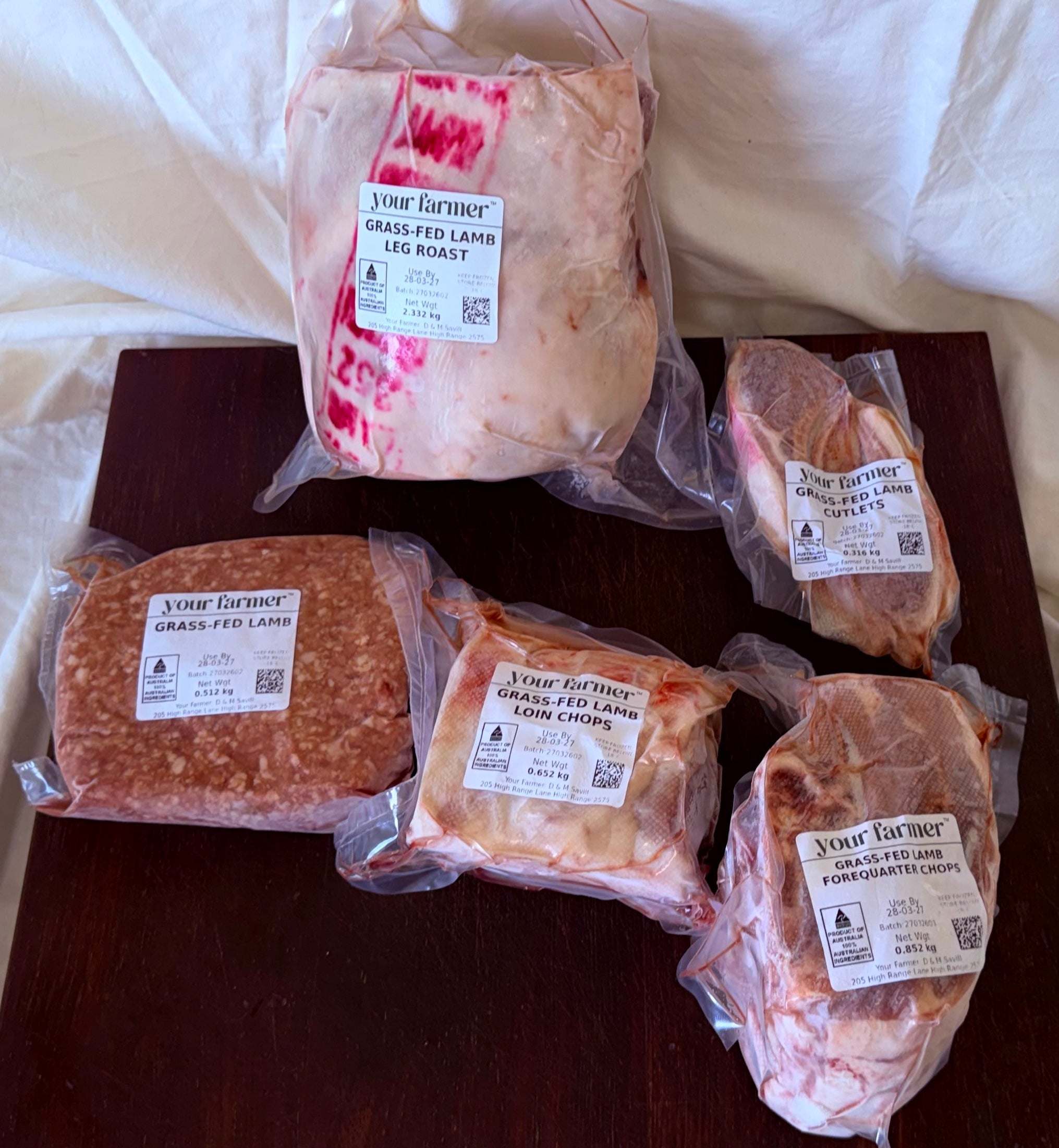
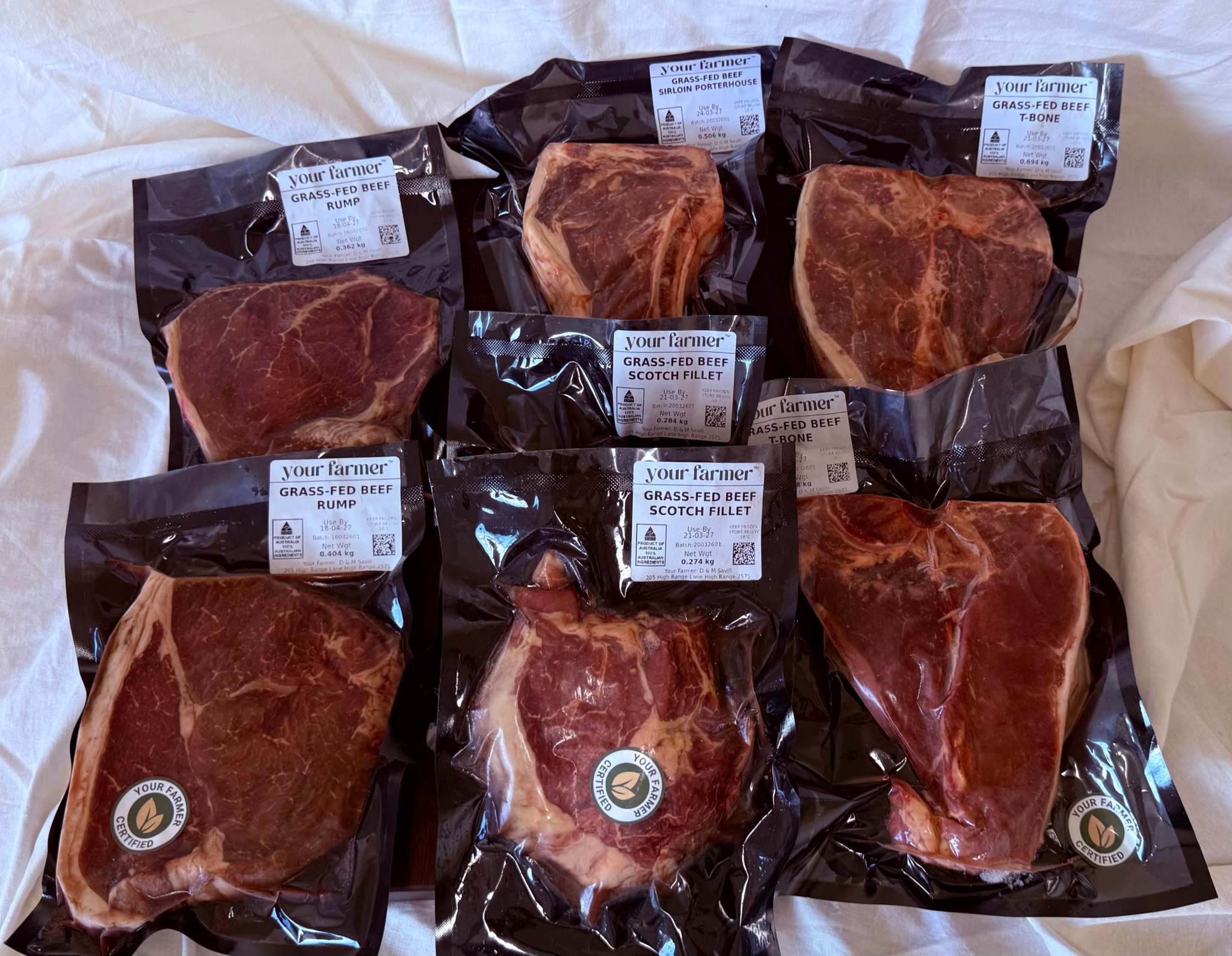
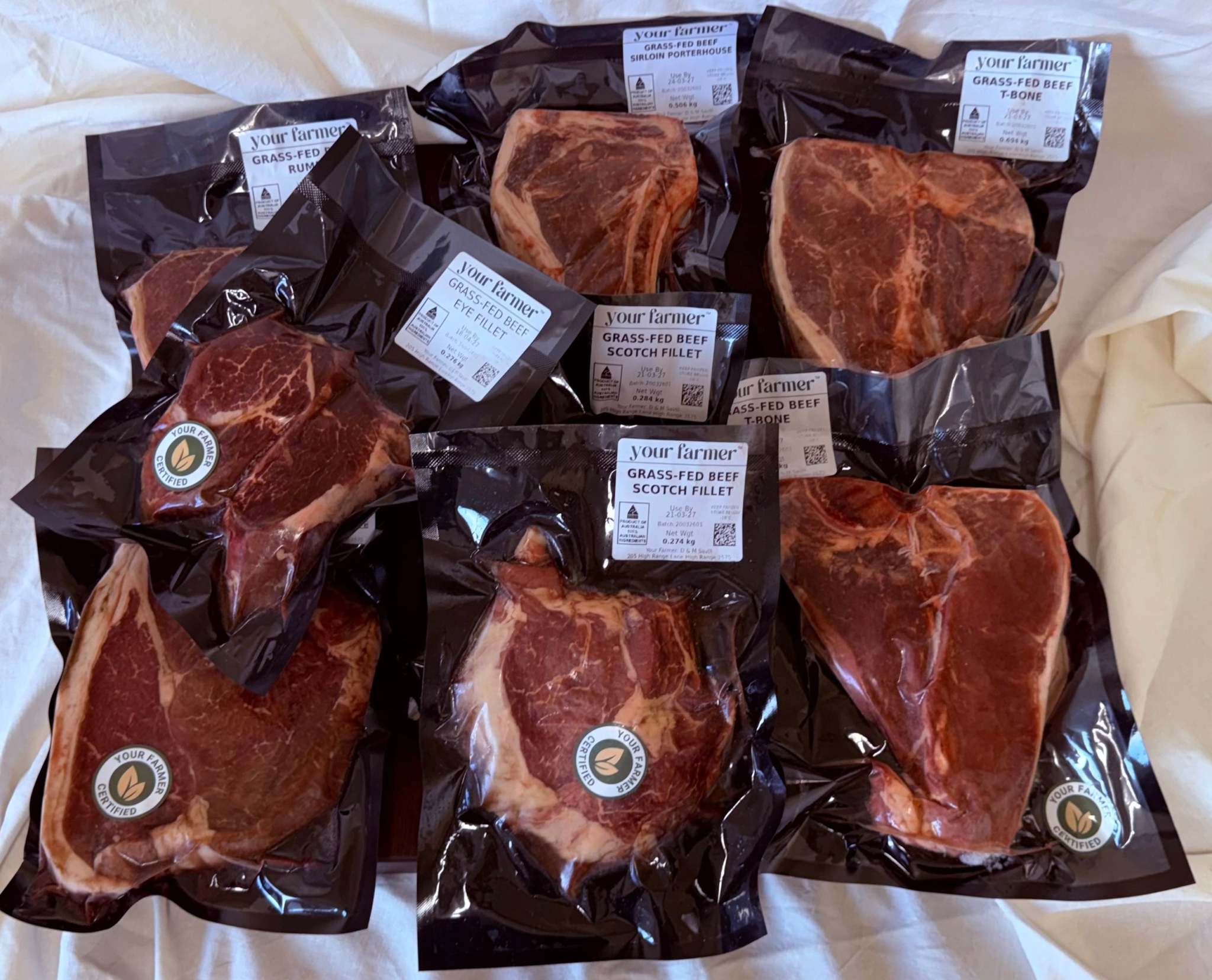
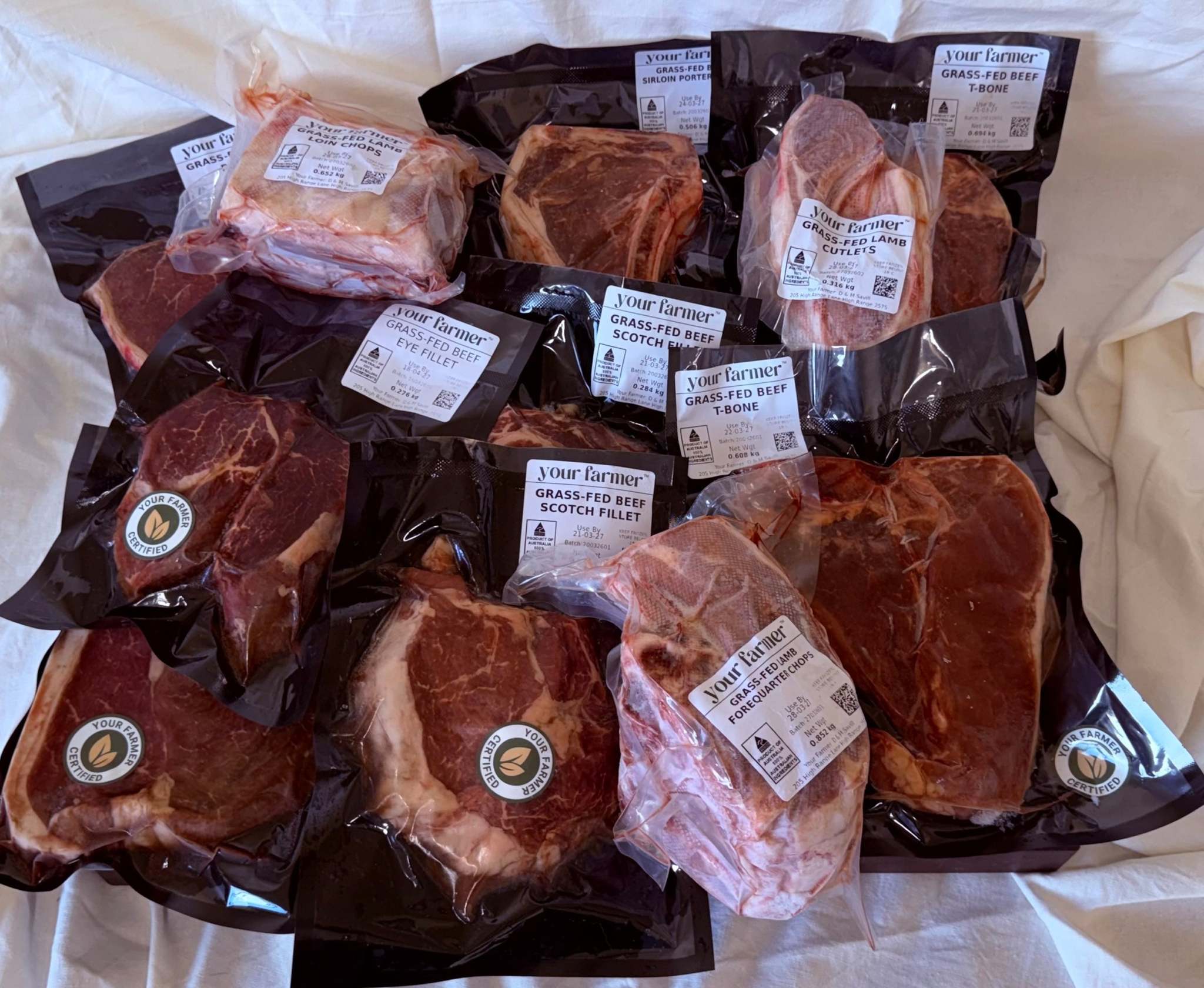
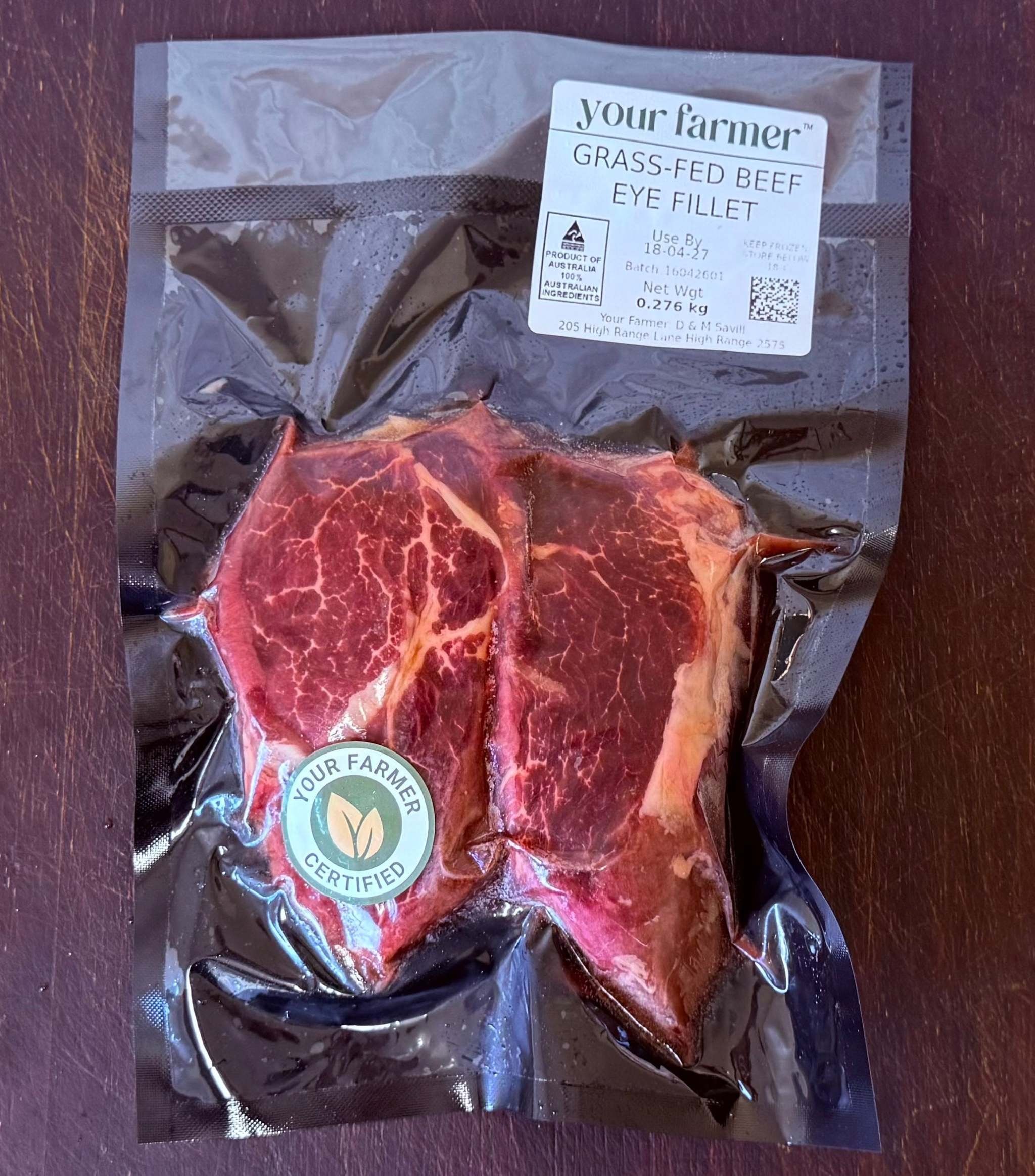
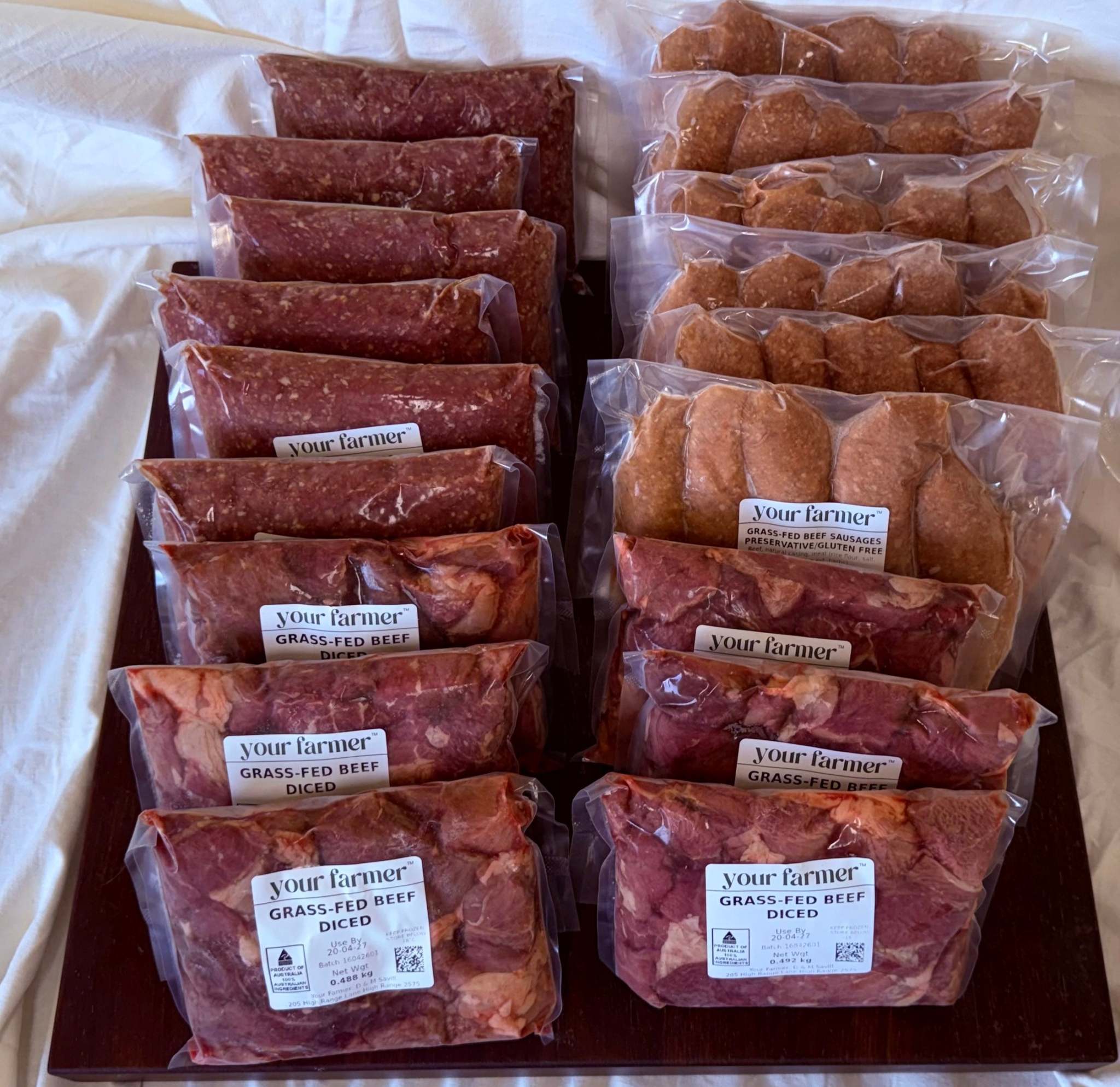
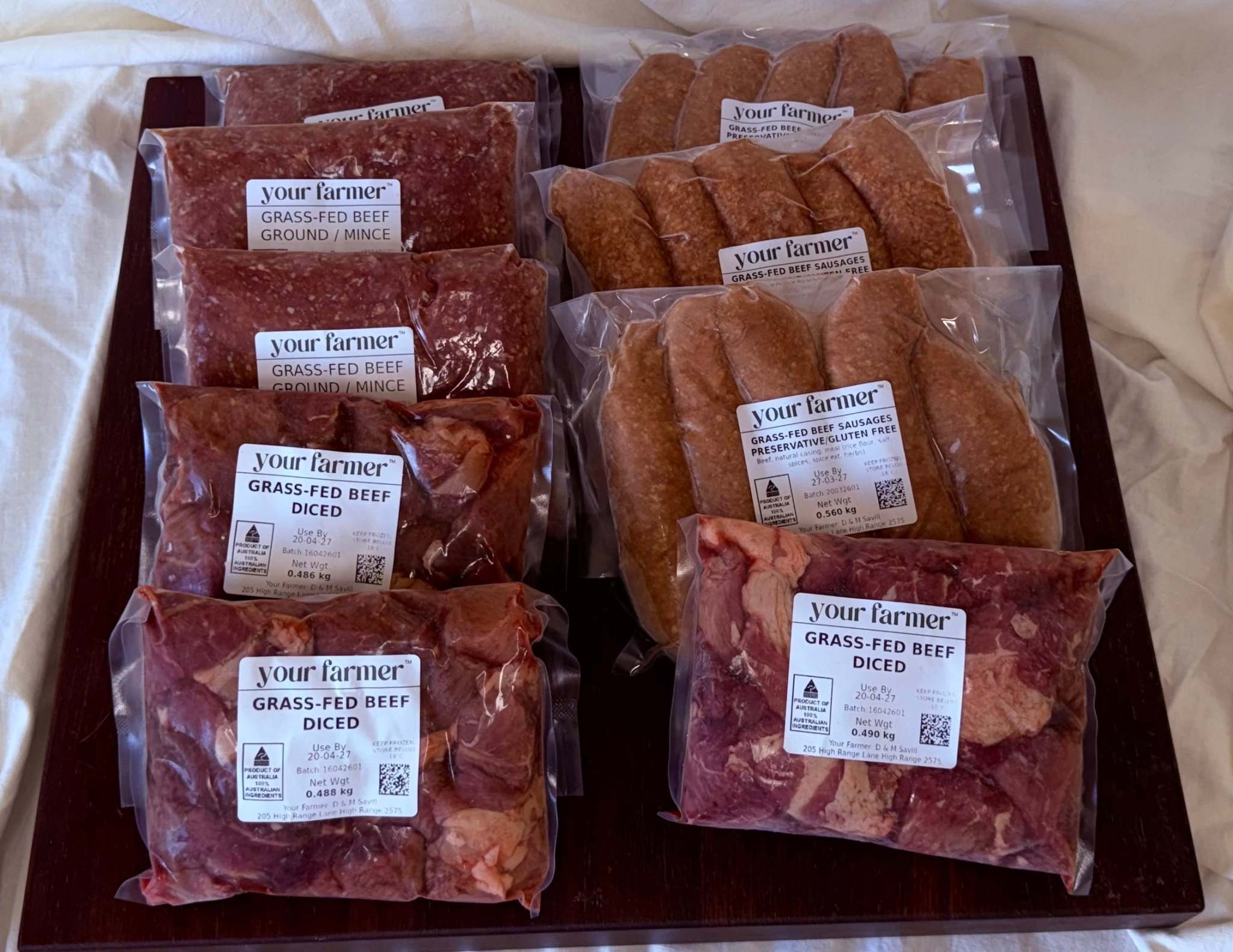
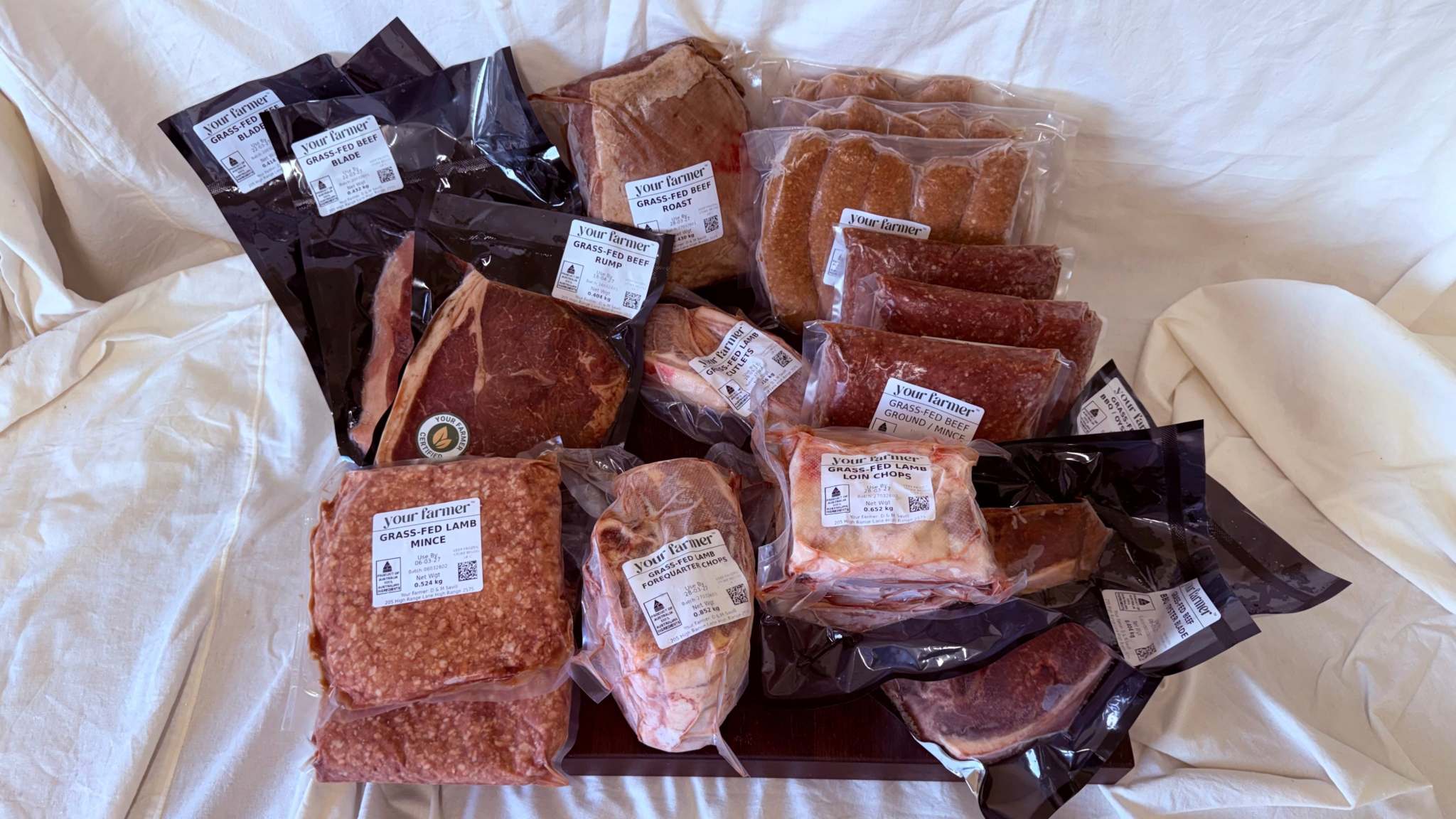
It's also why we put the farmer's name on your food. When you know who grew it and how, you can back the people doing this kind of work. Jeff's cattle are part of the same story: grass-fed on farms checked against the Eight Outcomes, and delivered through our grass-fed beef CSA share.
"Your Farmer"® and "Know Your Farmer"® are registered Australian trade marks owned by David Savill and used by Farmer Direct Online Pty Ltd (ABN 87 690 094 690) under exclusive license. The Eight Outcomes of Ecological Farming is copyright David Savill (2014) and licensed under CC BY-ND 4.0 (https://creativecommons.org/licenses/by-nd/4.0/).
Three Simple Steps
Your Farmers grow grass-fed beef and lamb, pastured eggs and the best eco-grown veggies and produce — every item grown to the same ecological standard, every farmer one you can know by name. One subscription, your whole real-food shop.
Subscribe to a share of the harvest, or start with a one-off fixed pack.
Pick your delivery rhythm and what's in the box. Skip or cancel anytime — no lock-in.
We deliver in a reusable esky we collect next time. No couriers, no waste.
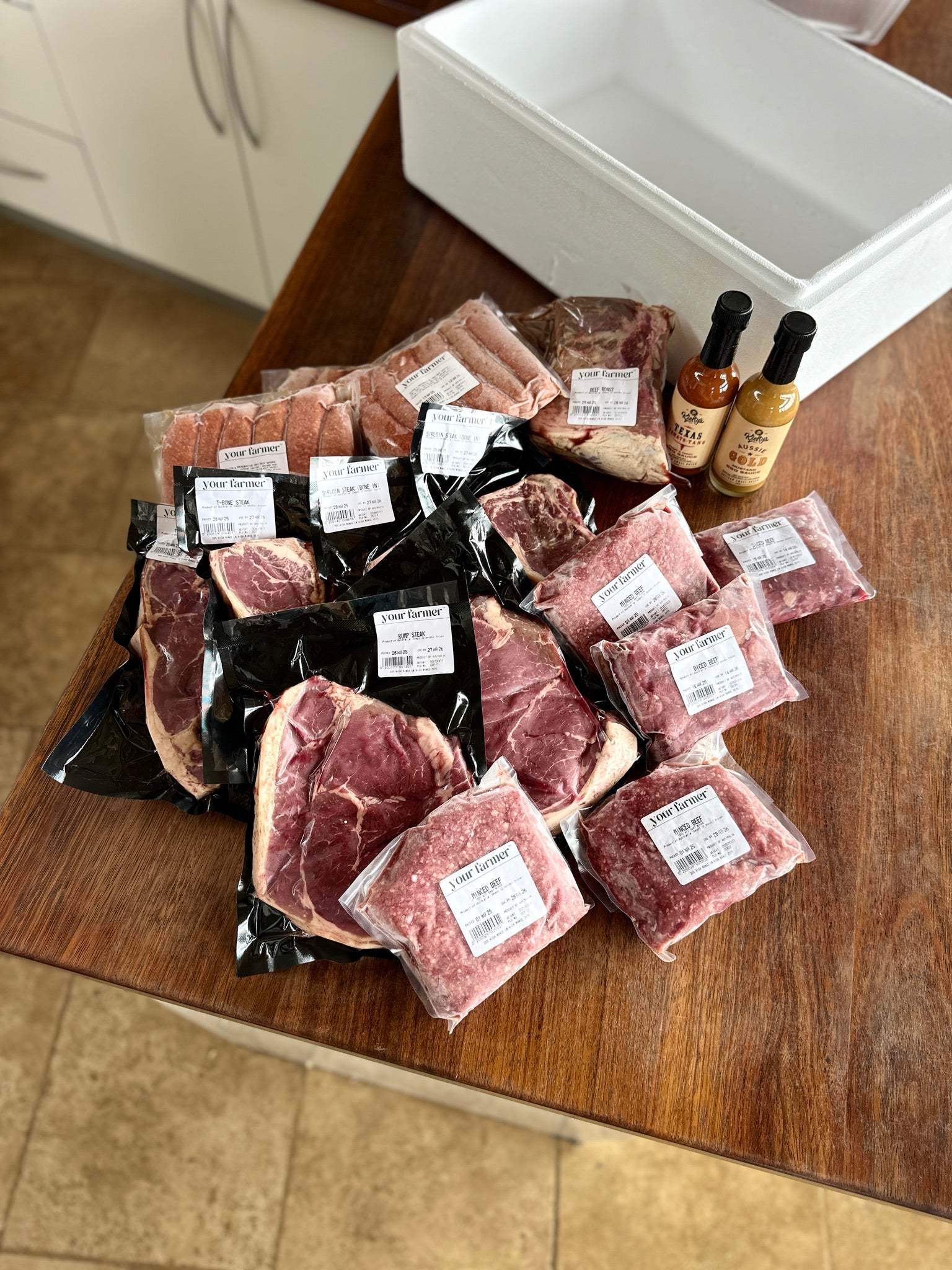
Grass-Fed Mince, Sausage and Diced Beef Pack
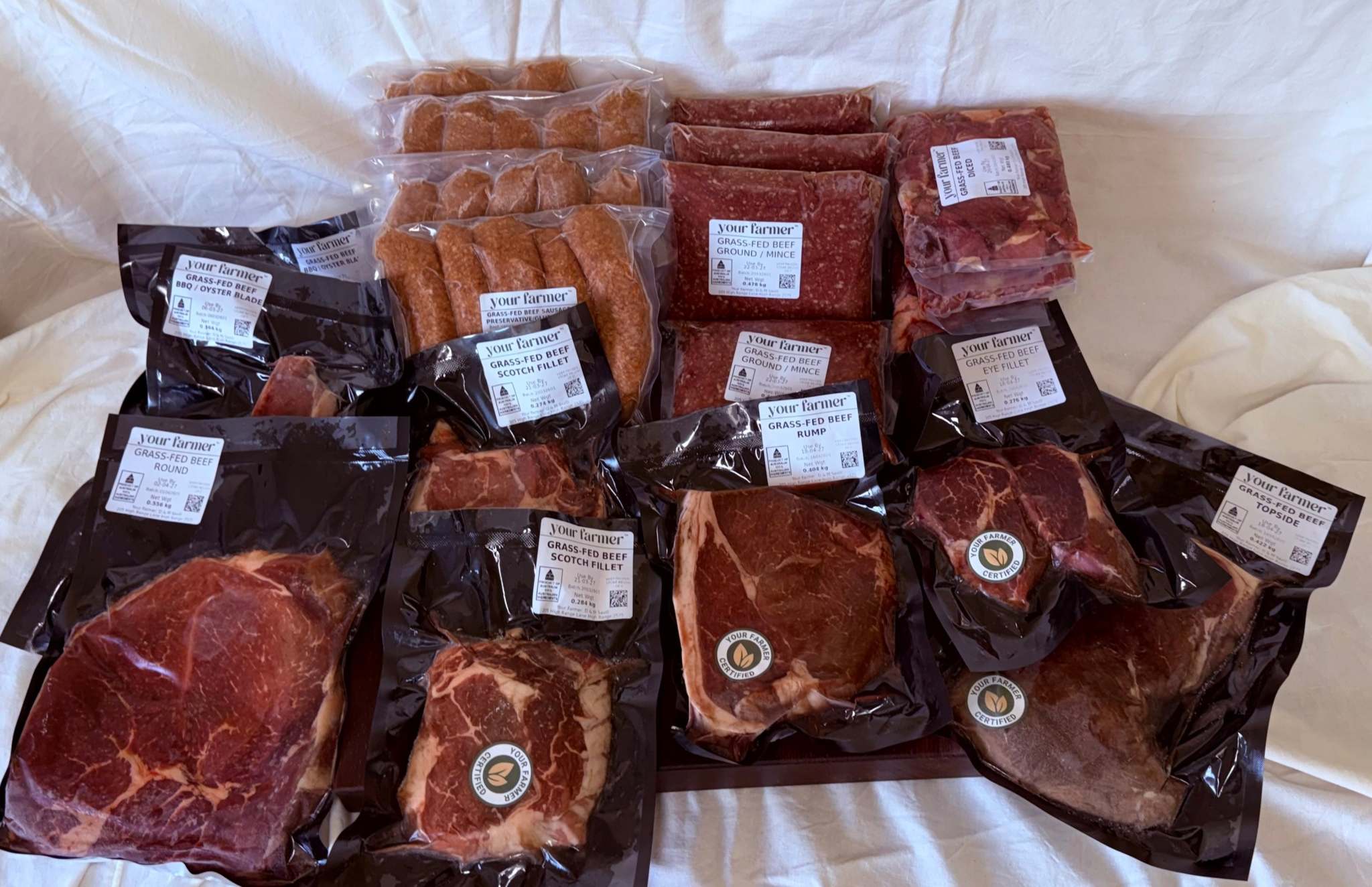
Grass-Fed Beef and Lamb BBQ Box
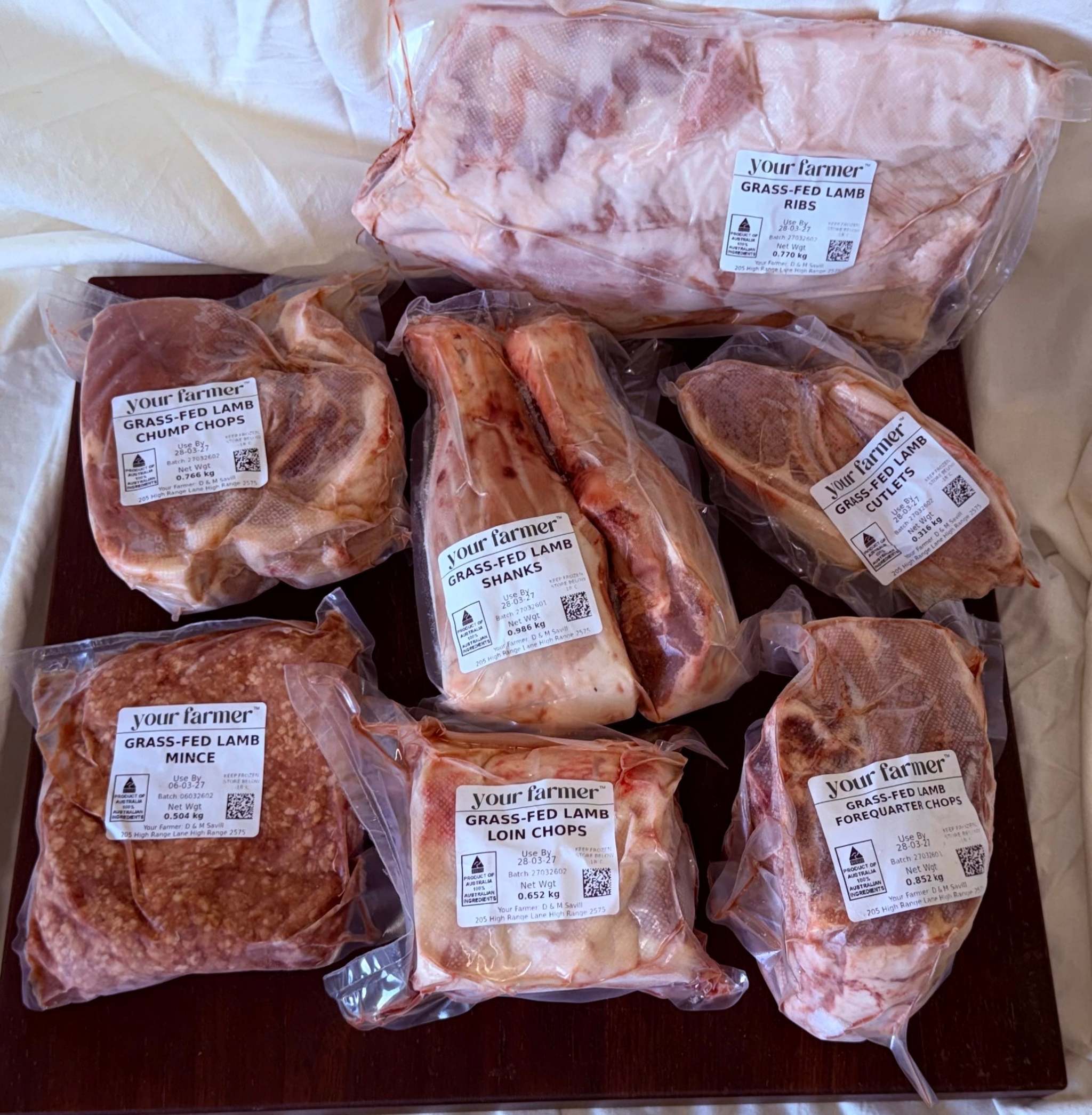
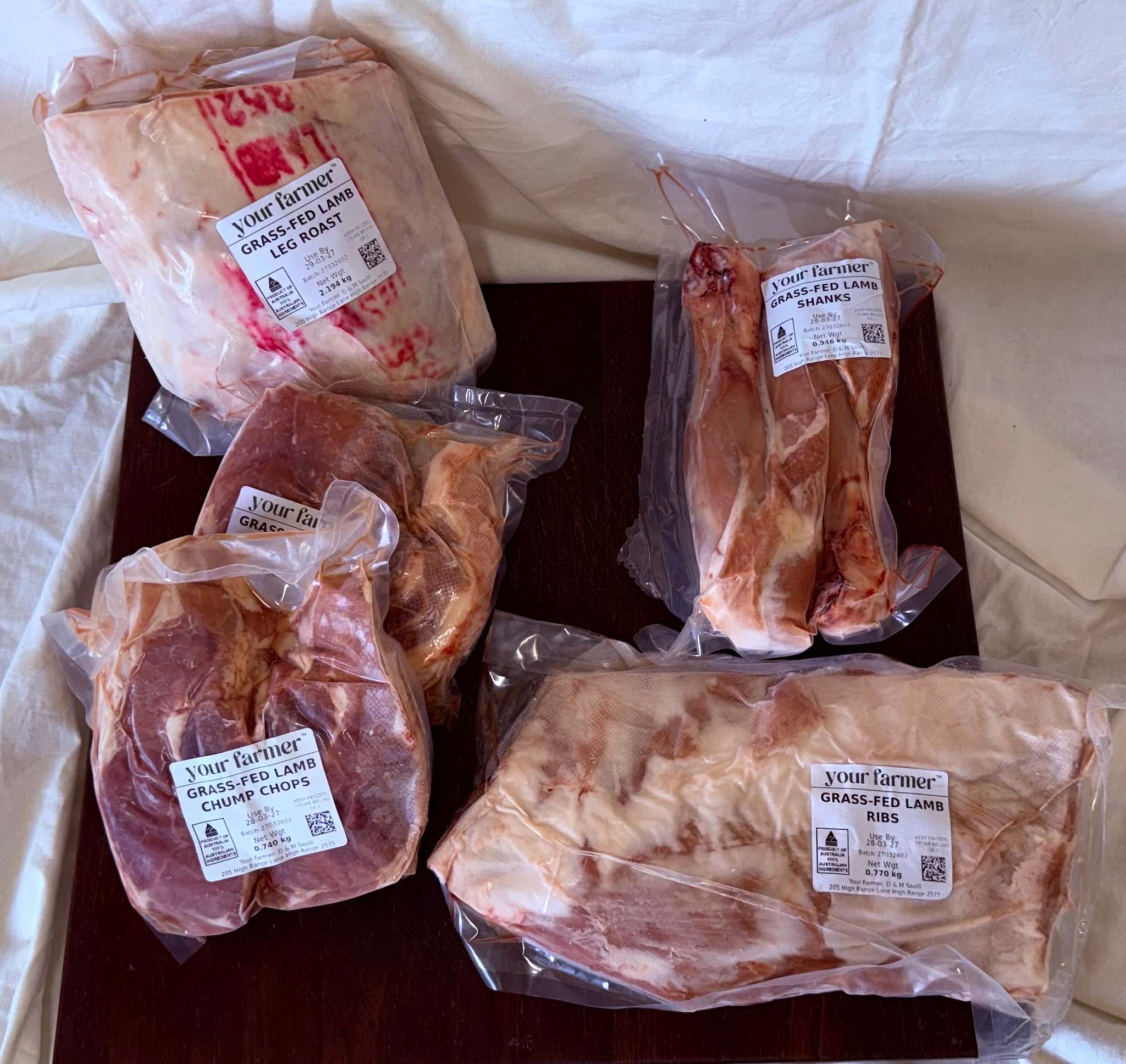
Pastured Lamb Roast and Slow-Cook Box
We'll check we deliver to your area.

Share:
Why Healthy Plants Don't Get Eaten: The Hidden Science Behind Pest-Free Crops